When I taste the soy sauces we carry, the first impressions are salt and umami—that familiar savory taste. Then the flavor seems to spread across the palate and linger. A little added to a dish can carry surprisingly far.
What gives it that reach?
Glutamate is an important part of the answer. But research on soy sauce suggests that the molecules around it matter too: small fragments of protein, amino acids that have changed form, and combinations whose effects cannot be predicted by tasting each component alone.
At the end of Soy Sauce 101, I wrote about a conversation at Kajita Shoten in Ozu, Ehime. We discussed why they bring the maturation of their Tatsumi Koikuchi to a close at around two years. One consideration was that, even as amino acids are released, some can undergo a change known as cyclization: part of the molecule closes into a ring.
That conversation left me wondering whether the question is about more than how much of each component a soy sauce contains. Could the form those components take—and the company they keep—help explain the flavors we enjoy?
This article follows that question into the chemistry of peptides and amino acid derivatives. The first part looks at published research. The second explores what it might mean for soy sauces matured through the seasons. That second part is my working hypothesis, rather than a demonstrated explanation of the bottles on our shelves.
Peptides: small pieces of a much longer chain
Proteins are long chains built mainly from about 20 kinds of amino acids. During soy sauce brewing, enzymes from koji—the mold culture grown on the brewing ingredients—break those chains into smaller pieces.
Some pieces are individual amino acids. Others still contain two, three, five, or more amino acids joined together. These shorter chains are called peptides.
Some peptides have a taste of their own, including umami or bitterness. Others influence the taste of surrounding ingredients. Some contribute to kokumi, a term used to describe sensations such as fullness, mouthfulness, and a lingering sense of richness. Here, “fullness” describes a sensory impression; it does not necessarily mean that the liquid becomes physically thicker.
Even a short chain allows a remarkable number of possibilities. With 20 amino acids to choose from, a chain of two has 400 possible sequences. A chain of three has 8,000; a chain of four, 160,000. Soy sauce does not contain every possible sequence, but the range quickly becomes much larger than a list of individual amino acids.
And the chains do more than break apart. Their building blocks can also change chemically or react with other substances in the mash.
Amino acid derivatives: when the building blocks change
An amino acid derivative is a molecule formed by chemically modifying an amino acid. Related changes can also happen to amino acids within peptides, so these categories overlap.
Several names appear in soy sauce research:
- Amadori compounds, formed through reactions involving sugars and amino groups, including those of amino acids.
- Pyroglutamyl peptides, which have a ring-shaped pyroglutamic acid unit at one end.
- Lactoyl amino acids, which have a chemical group derived from lactic acid attached to an amino acid.
- Succinoyl amino acids, which carry a group derived from succinic acid.
There is no need to memorize the names. The useful point is that brewing does not stop when proteins have been broken down into glutamate and other amino acids. Those molecules can continue to change.
One especially interesting finding is that a compound’s taste on its own can differ from its effect in a mixture.
A molecule can matter before you can taste it on its own
In a 2011 study, researchers at Ogawa & Co. identified Amadori compounds and pyroglutamyl peptides in a Japanese koikuchi soy sauce. Their concentrations were below the thresholds at which their individual tastes could be recognized. Yet adding them together to a reconstructed soy sauce increased its umami [1].
“Reconstructed” means that the researchers built a model of the sauce from measured components, then tested what happened when they added the compounds of interest.
At higher concentrations, the individual Amadori compounds tested tasted bitter or astringent—the drying sensation associated with strong tea—while the two pyroglutamyl peptides tasted sweet. Their combined effect in the model sauce was nevertheless an increase in umami.
There is a qualification: adding or removing individual compounds did not produce significant differences in that model. The combined result does not establish the size of each molecule’s separate contribution.
This is why the ring-forming change discussed at Kajita Shoten caught my attention. Free pyroglutamic acid and a peptide with a pyroglutamyl end are different molecules. Converting a free amino acid into a ring-shaped molecule is not the same thing as forming or modifying a peptide. We cannot treat every such change as a simple gain or loss of umami.
Bitter on its own, helpful in a mixture
A 2024 study offers another example. Researchers found that N-lactoyl leucine tasted sour, bitter, and astringent in water. In a solution of monosodium glutamate, or MSG, it enhanced umami and produced kokumi sensations; astringency was also reported [4].
MSG is the sodium salt of glutamic acid, used here as a controlled source of umami. These tests do not establish how much N-lactoyl leucine contributes to any particular bottle of soy sauce.
Still, the contrast is striking. Words such as “bitter” and “astringent” do not sound especially appetizing. But tasting a substance alone tells us only part of what it may do among other ingredients.
Nor are all these compounds present merely as minute traces. A 2013 study reported a total of 770 milligrams of pyroglutamyl dipeptides—two-unit peptides—per kilogram of the soy sauce analyzed, along with 135 milligrams of lactoyl amino acids. A succinoyl derivative of glutamic acid was also identified in a smaller amount [2].
These measurements are not a formula for deliciousness. Not every derivative produces umami, and concentration alone does not determine sensory impact.
What they suggest is a broader way of looking at soy sauce: how much glutamate is present, which other molecules surround it, and how those molecules work together. Umami starts to look less like a reading on a single scale and more like something with several dimensions.
What might change when a soy sauce matures through the seasons?
This is where the research starts feeding my imagination.
How might a temperature-managed brew finished in roughly six months differ from one that spends a year or two following seasonal temperatures? That is a comparison of possible brewing conditions, rather than a rule about every large or small producer.
Kajita Shoten describes Tatsumi Koikuchi as fermented and matured for at least 18 months, spanning two summers. Tokai Jozo, in Suzuka, Mie, lists a five-year maturation for its Sokobiki Tamari. These are different styles made by different methods, so the number of years alone cannot explain their differences.
Could the peptides and amino acid derivatives formed along the way help explain the way their flavors spread and linger? I find it useful to consider four possibilities.
The following are hypotheses about these sauces. The cited studies did not analyze Kajita Shoten’s or Tokai Jozo’s products.
1. Seasonal temperatures may change the timing of reactions
The activity of koji enzymes depends on temperature. In moromi—the fermenting mash—that cools in winter and warms in summer, protein breakdown will not necessarily proceed at a steady pace.
A peptide might form, remain for a time, and then be broken down further. During that interval, it could undergo another reaction. A mash following seasonal temperatures might therefore differ from a temperature-managed mash in the sequence of reactions and the time particular molecules remain available.
That does not mean slower brewing necessarily leaves more peptides behind. A longer process gives them more time to break down as well. My question is whether different paths through the process can leave different combinations at the end.
2. Whole and defatted soybeans can produce different peptide profiles
Whole soybeans retain their oil; defatted soybeans have had much of it removed before brewing. Along with subsequent processing, that changes the material the enzymes encounter.
A comparative study published in a 2021 journal issue examined taste-active peptides from soy sauces made with whole and defatted soybeans. Some peptides were found in both; others differed between the two [3].
This does not prove that whole-soybean sauce tastes better. It does provide evidence that the starting material can affect the range of taste-related peptides found in the finished sauce.
What happens when that difference is combined with seasonal temperatures and extended maturation remains an open question for the sauces we carry.
It is also worth keeping the variables separate: large producers do not all use defatted soybeans, and small breweries do not all use whole soybeans. Ingredients, temperature, and time each deserve consideration in their own right.
3. The second summer may arrive to find a different mash
The Maillard reaction is a family of reactions involving sugars and amino groups that helps develop soy sauce’s color and aroma. Temperature is one factor governing how it proceeds.
As a naturally brewed mash passes through summer, reactions that modify amino acids and peptides may occur alongside continuing protein breakdown.
What interests me is that the first and second summers need not begin with the same mixture. By the second summer, some amino acids and peptides may have accumulated. Others may already have been consumed or converted into something else.
Even if the weather were identical, a different set of starting molecules could lead to different products. I wonder whether this is part of what “two summers” means chemically for Kajita Shoten’s soy sauce. It is a possibility to investigate, rather than an established reason for their maturation schedule.
4. More time allows losses as well as gains
It is tempting to imagine that compounds contributing to richness simply keep accumulating as a sauce ages. The chemistry is unlikely to be that straightforward.
Peptides can break down further. Compounds can change into other compounds. Microorganisms also consume and produce substances as fermentation proceeds. The point at which a sauce is drawn off or pressed may therefore matter as much as the duration itself.
Ingredients, koji, mash management, and the brewery environment could all influence the eventual balance.
Perhaps the richness I enjoy has less to do with having the longest possible list of molecules than with having particular molecules in particular proportions. The research showing an effect below individual taste-recognition thresholds makes that question especially interesting.
One day, I would like to compare them
None of this establishes that peptides and amino acid derivatives explain the richness of the soy sauces on our shelves. We do not have analyses of these products that would let us make that claim.
In the previous article, I ended with the observation that brewers think differently about maturation time. Looking at the chemistry adds another question: even when two sauces spend the same number of years maturing, how similar are the changes taking place inside them?
I would love to line up the soy sauces we use and compare their peptides and amino acid derivatives as a whole. If their glutamate levels were similar, would the surrounding molecules be very different? And would those differences line up with what we taste?
The answer might point somewhere else. Aroma compounds, or substances derived from fats, might turn out to explain more of what I am noticing. If evidence takes us there, I will have to rethink the hypothesis.
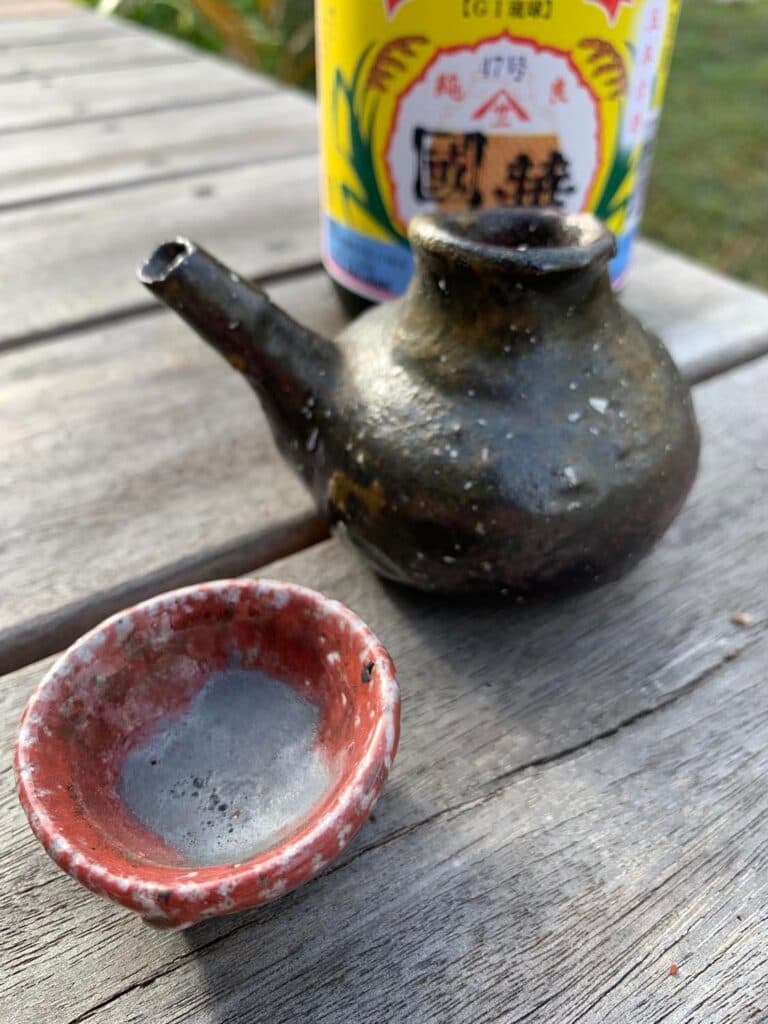
For now, I am tasting a drop from a small dish and wondering how much is happening in it.
Research cited
- Kaneko S, Kumazawa K, Nishimura O. Isolation and Identification of the Umami Enhancing Compounds in Japanese Soy Sauce. Bioscience, Biotechnology, and Biochemistry. 2011;75(7):1275–1282.
- Frerot E, Chen T. Identification and Quantitation of New Glutamic Acid Derivatives in Soy Sauce by UPLC/MS/MS. Chemistry & Biodiversity. 2013;10(10):1842–1850.
- Zhu X, Sun-Waterhouse D, Chen J, Cui C, Wang W. Comparative Study on the Novel Umami-Active Peptides of the Whole Soybeans and the Defatted Soybeans Fermented Soy Sauce. Journal of the Science of Food and Agriculture. 2021;101(1):158–166.
- Feng J, Huang Z, Cui C, Zhao M, Feng Y. Synthesis, Taste Characteristics and Taste Mechanism of N-Lactoyl Leucine from Soy Sauce Using Sensory Analysis and UPLC-MS/MS. Food Chemistry. 2024;454:139670.
Related reading
- Soy Sauce 101: A Closer Look at an Everyday Essential
- Why a Bottle Shop in Okinawa Sells Kombu
- How We Choose What Goes on Our Shelves
Soy sauces at Nagahama88
Tatsumi Naturally Brewed Whole-Soybean Koikuchi · 720 ml
A Japanese koikuchi soy sauce made with whole soybeans and wheat grown in the Nanyo region of Ehime. Fermented and matured for at least 18 months, spanning two summers.
- Producer: Kajita Shoten, Ozu, Ehime
- Available in our shop and online
View Tatsumi Koikuchi in our online store
Sokobiki Tamari · 100 ml
A tamari made with soybeans and salt, matured for five years in wooden vats. Drawn from the bottom of the vat without pressing, and left unpasteurized.
- Producer: Tokai Jozo, Suzuka, Mie
- Available in our shop and online